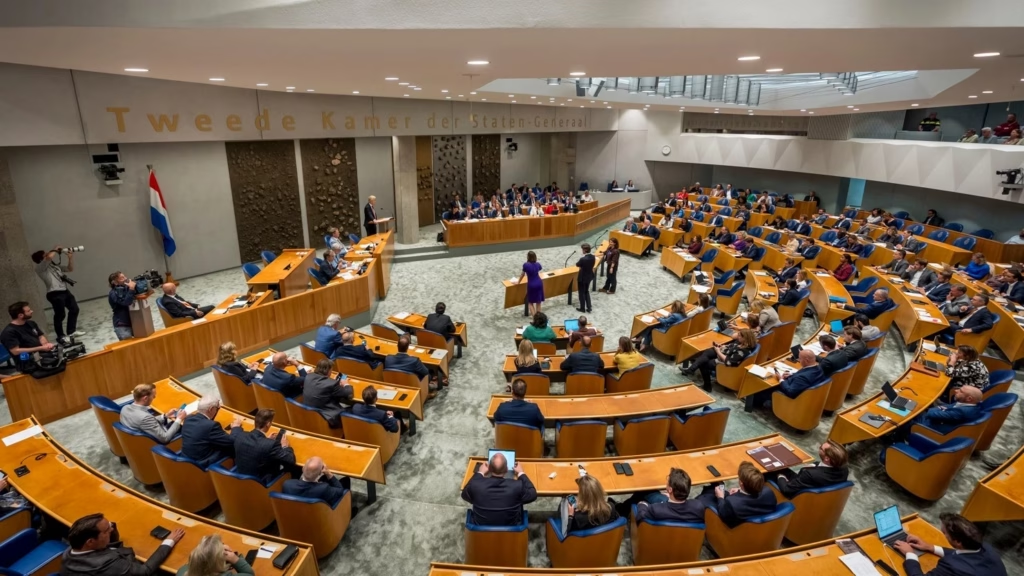

There are political moments that feel like a slow exhale after months of collective tension. With the process of new Dutch government formation, the Netherlands is now living through one of them. After snap elections, formation talks between D66 and the Christian Democratic Appeal (CDA) have introduced a sense of direction after an extended period when many wondered whether the wheels of public trust had rusted beyond repair. Instead, a new energy is rising, powered by leaders who still believe that financial discipline and social vision can exist in the same sentence.
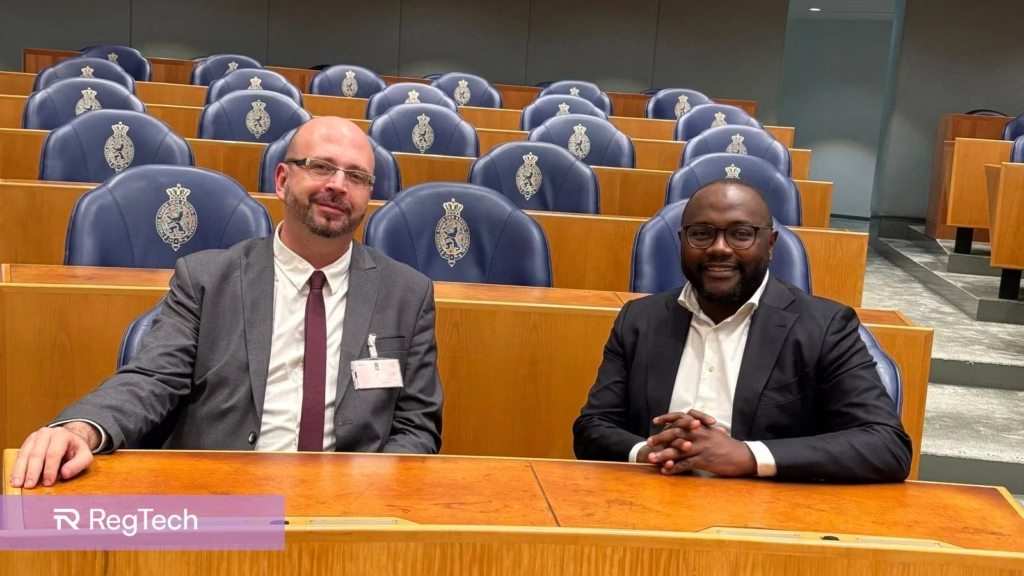
This awakening is particularly relevant for those of us who work in the field of regulatory technology and digital public systems. What I found during the recent visit was a country ready to think long-term again, ready to debate investment versus consumption without resorting to shallow wording, and ready to reconnect citizens with a political class that had, for a while, felt a bit distant. Leaving The Hague, I felt something I had not expected from Dutch politics this year: confidence.
That confidence matters far beyond their borders. The choices made in these coalition talks will possible shape how Europe approaches, among others, digital taxation, electronic invoicing, and cross-border digital identity. And that, whether policymakers admit it or not, directly influences the future of tech companies like ours in Dubai, who are building the digital platforms that keep governments’ fiscal systems stable and citizens’ interactions with public institutions smooth, clear, and fair.
What to expect?
So, let’s walk through what is taking place in the Netherlands right now, why it is resonating across Europe, and how it aligns with the EU’s ambitious VAT in the Digital Age (ViDA) and EU Digital Wallet agendas. Then, I will share our perspective at The RegTech Dubai: what we see coming, why the Dutch moment matters, and how this renewed political spirit may finally push governments to modernize revenue systems without hesitation.
5 Key Takeaways
1. The Dutch are restoring political confidence after a period of uncertainty. Following snap elections, the formation talks between D66 and CDA have brought a renewed sense of direction, replacing public doubt with a feeling that serious, long-term governance is once again possible.
2. The Netherlands is shifting toward investment-minded governance instead of short-term fixes. Dutch leaders are openly calling for fiscal rules that distinguish between day-to-day spending and long-term investments, signaling a political environment that prioritizes structural planning over improvisation.
3. Dutch political decisions will influence the EU’s digital taxation and digital identity trajectory. The country’s position in coalition talks places it in a strong role to shape further how Europe rolls out VAT in the Digital Age, mandatory e-invoicing, and the upcoming European Digital Identity Wallet.
4. The Dutch moment aligns with The RegTech Dubai’s view that digital platforms are national infrastructure. Our work shows that effective digital identity systems and e-invoicing platforms require political leadership committed to long-term thinking. The Dutch shift mirrors this philosophy and suggests stronger, fairer revenue systems ahead.
5. This renewed political energy in the Netherlands has implications far beyond its borders. A government willing to rethink its budgeting rules and embrace digital modernization sends a powerful signal across Europe. It reinforces the idea that trust in institutions can be rebuilt and that digital public services can become credible, daily tools for citizens.
Dutch New Government: Thinking Beyond the Next News Cycle
Across Europe, there is a quiet fatigue with politics that feel improvised. Citizens sense it. Businesses sense it. Even government departments sense it. The Netherlands, with its new political leadership, is now offering something different: a revival of thoughtful, structured governance.
D66 and CDA entered coalition talks with a shared awareness that their country needed more than temporary political solutions. The two parties have spent days shaping the contours of what could become one of the most structurally ambitious governing agreements in years.
Their early discussions focused heavily on finances, long-term socioeconomic policy, and the business environment. That alone says something important. After a period of fragmented politics, leaders like Rob Jetten and Henri Bontenbal are now speaking openly about the difference between spending that disappears and investments that build futures. Bontenbal said it plainly: the Dutch budgeting system lumps daily expenses with long-term investments, and that has to change.
It is rare to hear fiscal nuance in political debates. Yet here, nuance is exactly what is returning to the forefront. Jetten spoke of the need for a stronger investment climate, while acknowledging that citizens also want clarity on how major initiatives will be funded. Bontenbal reinforced the idea that investments should not be treated as mere costs. Both leaders are pushing for a budgeting philosophy that does not punish the country for planning ahead.
The presence of senior figures such as Laura van Geest of the Dutch Financial Markets Authority (AFM), Kim Putters of the Social and Economic Council, and Ingrid Thijssen of the employers’ organization VNO-NCW added substance to the talks. Their expertise helped steer the coalition toward a plan rooted in evidence rather than improvisation.
Where Europe Stands: Digital VAT, Electronic Invoicing, and a Wallet That May Redefine Public Trust
The EU’s VAT in the Digital Age initiative is one of the most ambitious regulatory projects in the world today. It aims to reduce fraud, standardize real-time reporting, modernize VAT rules for digital platforms, and establish mandatory e-invoicing across the single market.
The Netherlands, under its emerging coalition, is now positioned to influence how this will be implemented on the national level. If the Dutch government adopts more investment-friendly rules, it could accelerate national readiness for these digital tax reforms. And that matters, because ViDA’s success will not depend on legal texts alone, it will pivot on governments having digital systems that actually work.
Then comes the European Digital Identity Wallet, the tool meant to become every citizen’s secure gateway to online public services. When I spoke with Dutch officials, what struck me most was their sense of responsibility toward trust. They know trust is fragile. They know the wallet must serve citizens, not confuse them, and know digital identity must be both protected and accessible. Their tone was not panicky. It was thoughtful.
This balance between ambition and responsibility is exactly the kind of leadership the EU needs if it wants digital public services to be more than symbolic milestones.
Dutch New Government: Support to Long-Term Systems?
Our work in Dubai has always focused on one question: how do we help governments build digital platforms that truly support revenue collection, compliance, and public service delivery?
Digital platforms are not decoration. They must be seen as infrastructure. And infrastructure only thrives when political leaders are willing to think beyond election cycles. The Dutch new government, through its coalition talks, is signaling just that. They want fiscal policy that distinguishes between spending and investment. That approach mirrors what we have been championing across Africa, the Middle East, and parts of Europe: governments must view digital public systems as long-term national assets.
The Dutch moment gives us hope because it suggests a return to seriousness, serious budgeting, serious planning, and serious citizenship. Whether it is digital identity, online business portals, or e-invoicing systems, governments that see digital services as investments create better outcomes for citizens. And from what we have seen, the next Dutch government will poised on creating fairer tax environment, stronger compliance, and even more transparent public institutions.
From The RegTech standpoint, this new attitude could accelerate Europe’s transition to synchronized digital compliance, supported by real-time data exchanges and unified platforms. It could help governments prepare for ViDA without last-minute panic and move digital identity wallet from a theoretical conversation to a daily, practical tool. And most importantly, it could inspire other countries, especially developing ones, to treat their digital transformations as essential state functions.
From The Hague to Brussels to Dubai: A Shift That Travels
Leaving the Netherlands, I reflected on the difference that political tone can make. When leaders acknowledge the complexity of governing yet still push forward, it sets a direction that others can follow. The Dutch have an opportunity to do exactly that with the formation of new government. And because of it, Europe’s digital agenda suddenly feels more achievable.
Renewed politics lead to renewed systems. Renewed systems lead to renewed trust. And renewed trust is the starting point for digital public services that carry real legitimacy.
The future coalition’s willingness to rethink budgeting rules aligns perfectly with the EU’s push for more structured digital identity and taxation which requires certain investment. But obviously, returns are much greater! It also aligns with what we see across the developing world. Governments are looking for clarity, stability, and systems that reduce uncertainty rather than create it.
Finaly, at The RegTech, we see how the right political environment accelerates digital progress. The process of formation of the new Dutch government is sending signals that faith in public institutions, confidence in long-term planning, and sureness that governments can serve citizens better through modern tools, is still possible.
And yes, this political moment, emerging from the Netherlands, is not a local story. It is a European story. And for those of us who work with governments globally, it is a reminder that political renewal often launches serenely, through financial talks, through consultations, through a budget debate that treats investments as assets rather than burdens.

Founder of The RegTech, focused on inclusive digital policies and scalable solutions through multilateral collaboration for global governance and development.