
Some organizations measure progress in product launches or funding rounds. Others chart it by the airports passed through, the ministries entered, and the rooms where policy is argued rather than announced. Over the past year, The RegTech has been present in many such places. Geneva and Washington, Samarkand and Lusaka, Dubai and a growing number of capitals across the Global South. Not as a vendor, nor as a campaigner, but as a participant in a widening conversation about how states govern in a digital age and what happens when they fail to do so well. Thus, this year digital governance update was in our scopes!
By the end of 2025, it had become clear that this was no longer a niche advisory firm commenting from the margins. The RegTech had matured into a global interlocutor on digital governance, increasingly recognised in multilateral forums and policy circles for a consistent argument: that digital transformation succeeds only when it is citizen-centric, measurable, and grounded in trust. Experience across jurisdictions with strained public finances, uneven institutions, and rising expectations has sharpened this deceptively simple proposition.
This growth was earned through sustained engagement with governments confronting the practical limits of reform. Across regions, the same tension surfaced repeatedly: technology offers reach and efficiency, but without governance it risks deepening exclusion and eroding legitimacy. The RegTech’s work in 2025 sat squarely within that fault line.
5 Key Takeaways
1. Global Presence and Influence: In 2025, The RegTech established itself as a recognized voice in international digital governance, participating in UN forums, IMF and World Bank meetings, and key conferences across multiple continents. Its presence shaped the conversation on citizen-centric, trustworthy, and measurable digital transformation.
2. Strengthening Governance Through Technology: The RegTech highlighted the importance of integrating technology with strong governance frameworks. Its work ensured digital systems are implemented effectively, enhancing inclusion, legitimacy, and the practical functioning of public services.
3. Advancing Revenue Assurance and Fiscal Systems: Through work on e-invoicing, fiscalization, and administrative modernization, The RegTech contributed to stabilizing public finances, improving compliance, and enhancing state capacity, directly supporting effective service delivery.
4. Building Trust as Core Infrastructure: Trust emerged as a central focus. The RegTech emphasized that reliable systems, consistent enforcement, and transparency create citizen confidence, making trust a measurable and operational component of digital governance.
5. Operationalizing Political Commitment: The RegTech reinforced the importance of sustained leadership in digital transformation. By engaging with governments and policymakers, it helped translate digital visions into practical, citizen-centered outcomes, turning digital infrastructure into a strategic national asset.
January: A Global Mandate Takes Shape
January opened with a moment of reflection rather than proclamation. Joining a virtual expert group convened by the United Nations Commission on Science and Technology for Development, supported by UN DESA’s Digital Government Branch, it was immediately clear that this was less a celebration of progress than an audit of reality. Voices from across regions gathered to assess two decades of digital transformation since the World Summit on the Information Society.
For The RegTech, invited as one of only two private-sector participants, the discussions accentuated a familiar imbalance. E-government has delivered efficiency and transparency in some jurisdictions, while elsewhere, notably across parts of Sub-Saharan Africa, Oceania, and Southeast Asia, structural barriers continue to limit access. Digital progress, the group acknowledged, has been real but uneven.

“True strength of technology is not just in making life easier for a few but in empowering everyone, everywhere. Holistic Future of Digital Governance invites you to discover how innovation is restructuring the way governments work, communities thrive, and people connect.“
The RegTech published an ebook to support the process of preparation for the WSIS 20+.
What cut through was the human dimension. The RegTech intervened with a measured but direct message: technology is not neutral, and digital transformation that prioritises speed over inclusion entrenches divides rather than closing them. That insight set the intellectual tone for the year ahead.
February: Confronting Compliance and the Cost of Inaction
If January was about reflection, February was about consequence. The debate moved from principles of digital governance update to the less photogenic question of fiscal compliance, an area where delay carries a measurable price. As HMRC opened its consultation on e-invoicing in the UK, the moment served as a reminder that digital reform often advances not through vision statements, but through administrative decisions that model incentives across entire economies.
The RegTech used the consultation as an entry point to widen the discussion. E-invoicing, it argued, is rarely a technical transformation. It is a structural response to persistent revenue leakage, invoice manipulation, and enforcement gaps that erode public finances over time. The sums involved are anything but abstract. They surface later as underfunded services, constrained policy choices, and declining confidence in the fairness of the system.
What distinguished February’s analysis was its refusal to frame compliance as coercion. Properly designed, digital compliance systems protect rather than punish. They level the field for compliant businesses, increase visibility for tax authorities, and stabilise revenue without expanding discretionary power. When governments hesitate, the burden shifts to citizens and honest firms.
The underlying message was unambiguous. In an economy where transactions are increasingly digital, analogue oversight is no longer a neutral choice. It is a decision with fiscal, social, and political consequences, and one that governments can ill afford to postpone.
Digital Governance Update: From Local Player to Global Presence
By early spring, digital governance update was increasingly discussed in practical rather than aspirational terms. At the 28th Session of the UN Commission on Science and Technology for Development in Geneva, attention centred on the role of digital systems as a core component of public administration. The discussions reflected a growing consensus that digital governance is no longer optional for states seeking to deliver services, manage resources, and maintain institutional credibility.
The RegTech’s contribution focused on implementation. Drawing on experience across Europe, the Pacific, and parts of Africa, The RegTech argued that digital governance succeeds when governments design it as infrastructure rather than as a policy initiative. Secure digital identity, interoperable platforms, and reliable revenue systems were presented not as innovations, but as prerequisites for inclusion and administrative effectiveness.
Much of the dialogue addressed the persistence of the digital divide. Limited connectivity, uneven digital literacy, and fragmented governance frameworks continue to restrict access to public services for large parts of the population in many regions. These constraints were discussed as issues with direct implications for access to rights, public trust, and social participation.
And the recurring theme was the role of trust. Concerns around data protection, accountability, and the governance of emerging technologies were widely acknowledged. Participants emphasized that digital systems gain legitimacy only when citizens understand how governments use their data and when authorities demonstrably enforce safeguards.
May: Revenue Assurance in Practice
By May, attention turned toward revenue assurance as a core element of state capacity. Discussions increasingly focused on how governments observe, measure, and manage economic activity in environments where transactions are becoming predominantly digital. The emphasis was less on reform announcements and more on system performance.
The RegTech’s analysis during the month examined the practical role of fiscalization and e-invoicing in strengthening administrative capability. Coverage of Oman’s planned e-invoicing rollout highlighted the value of phased implementation, regulatory clarity, and sustained engagement with the private sector. Our approach showed how governments can integrate digital tools into existing tax systems without disrupting commercial activity, while improving accuracy and transparency.
Further analysis extended to advanced economies. The exposure of electronic sales suppression practices in parts of the United States, including regulated sectors such as cannabis, demonstrated that visibility gaps persist where regulatory frameworks and digital oversight evolve at different speeds. These cases reinforced a broader institutional point: revenue systems depend on reliable data flows and consistent enforcement rather than economic maturity alone.
The month’s discussions positioned revenue assurance within the wider digital governance agenda. Strengthened tax administration supports budget credibility, public investment, and service delivery. As governments face fiscal pressure and rising expectations, the ability to account for economic activity emerged as a foundational capability.
Digital Governance Update: June Delivery Over Declarations
The RegTech’s June coverage focused on the operational realities of digital public services. Analysis highlighted how implementation capacity, workforce training, and institutional alignment determine whether platforms extend beyond urban centres and formal sectors. In regions where informal economies remain significant and administrative resources limited; systems must be resilient, accessible, and capable of operating under constrained conditions.
These themes featured prominently at the UN Public Service Forum in Samarkand. Officials acknowledged that digital inclusion depends on sustained investment in skills, institutional processes, and public communication. The debate reflected a growing understanding that digital public services require ongoing maintenance and adaptation rather than one-off deployment.
Examples examined during the month illustrated gradual progress. In parts of Africa, tax administration reforms advanced through incremental system upgrades and staff capacity building. In Albania, adjustments to service delivery focused on interoperability and user experience within existing frameworks. These efforts underscored the importance of continuity and institutional learning.
June also reinforced the role of trust as an operational factor. Citizens engage with digital systems when services are dependable and responsive. Administrative credibility develops through consistent performance rather than formal declarations. By the end of the month, delivery had become the principal metric shaping how stakeholders judged digital governance initiatives, setting the agenda for subsequent discussions on resilience and long-term sustainability.
July: Rebuilding Trust Through Systems That Work
July coverage aligned closely with the OECD’s Government at a Glance 2025 report, which highlighted pressures on public finances, service capacity, and public confidence across many jurisdictions. The report reinforced a central observation emerging throughout the year: trust is sustained through systems that function consistently and predictably over time.
Attention turned to the concept of Safe Digital Public Infrastructure, with emphasis on governance frameworks that prioritise data protection, interoperability, and continuity. Discussions underscored the importance of institutional ownership, clear accountability, and long-term maintenance. Digital platforms were assessed not by their novelty, but by their ability to support essential services without disruption.
Case analyses examined the effects of system failures on administrative credibility. Interruptions in identity platforms, payment systems, or service portals had lasting implications for public engagement. Institutional recovery following such failures requires sustained effort and demonstrable improvement.
Throughout July, digital trust was treated as cumulative. Each secure interaction, successful transaction, and accessible service contributes incrementally to confidence in public institutions. This framing positioned trust as a measurable outcome of governance rather than an abstract objective. By mid-year, stakeholders increasingly judged digital governance initiatives by their durability and their ability to sustain public trust over time.
August: Digital Government as Economic Strategy
During August, The RegTech’s focus had shifted to the economic implications of digital governance. A recent World Economic Forum analysis estimated that digital government could generate global savings between $5.8 trillion and $9.8 trillion by 2034. These figures, achievable in under a decade, reflect efficiencies across tax administration, healthcare, business licensing, and other routine government processes.
Practical examples illustrate the scale of impact. In Rwanda’s Musanze District, the implementation of a digital tax system in 2013 raised local revenue by nearly 50 percent in a single year. South Korea’s KONEPS online procurement system is estimated to save $8 billion annually by reducing transaction costs and limiting fraud. India’s Aadhaar digital identity system supports more than 95 percent of financial transactions, enabling access to banking, welfare, and government services across the population.
E-invoicing also emerged as a driver of economic efficiency. A global survey by the Center for Economics and Business Research quantifies the potential gains at $616 billion annually across major economies, including the U.S., U.K., France, Germany, India, and Australia. Digital invoicing reduces operational costs, accelerates cash flow, and mitigates fraud risk, while businesses that fail to adopt these systems face growing disadvantage.
We made it clear that digital governance functions as a strategic economic asset as well, delivering measurable savings, revenue growth, and improved participation across societies.
Digital Governance Update: Autumn Expansion Across Continents
September and October highlighted The RegTech’s most visible expansion to date. Under the leadership of CEO Igor Ujhazi, the organization participated in pivotal gatherings across continents, establishing a consistent voice in global digital governance.
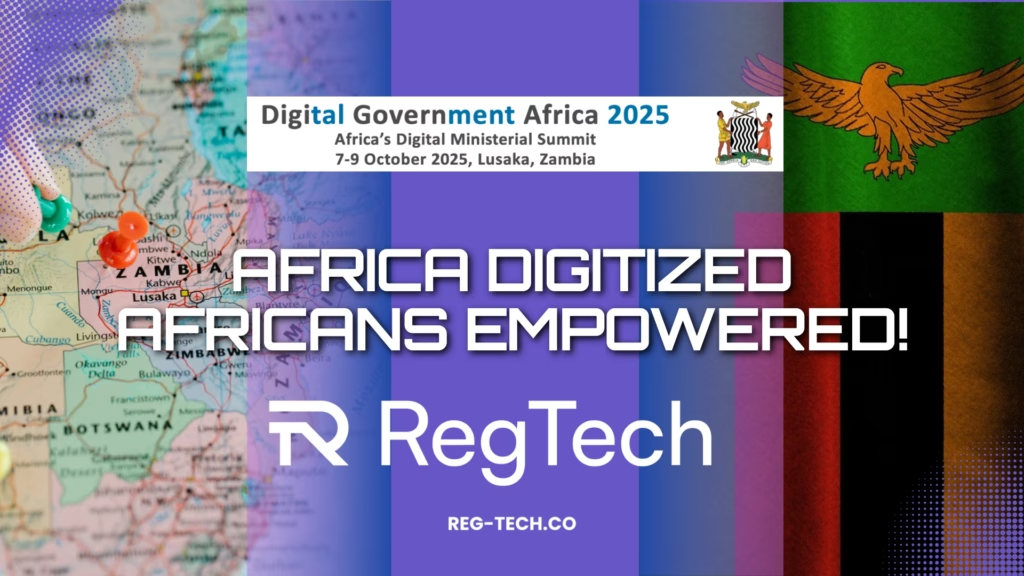
At Digital Government Africa 2025 in Lusaka, The RegTech engaged ministers, policymakers, and civic leaders on the role of domestic revenue in financing a digital future. Discussions emphasized how fair and efficient tax collection creates fiscal space for digital services such as identity systems, licensing platforms, and government payment infrastructure. The RegTech showcased practical examples where digital compliance systems improved revenue, strengthened citizen trust, and supported effective governance.
In Dubai, at GITEX Global, we focused on sovereignty in the digital era, presenting how governments can assert control over platforms, data, and digital identity. The organization reinforced that digital infrastructure is a strategic asset that props up state capacity and public confidence. At the Asia Pacific Cities Summit, The RegTech engaged with municipal leaders on operationalizing digital governance update. Case studies demonstrated how city governments can use digital systems to manage fiscal flows, deliver services, and strengthen citizen engagement effectively. Participation at the IMF and World Bank Annual Meetings in Washington emphasized digital governance as a fiscal strategy. As always, we argued for the capacity to measure obligations and manage growth as a critical component of state resilience, particularly in periods of fiscal pressure.
November: The Quiet Power of Political Will
Every public digital success begins gins with political will, the subdued, decisive force that determines whether digital visions become everyday realities. Around the world, governments talk about transformation with enthusiasm, yet the difference between ambition and achievement is almost always political commitment. Leaders who plan beyond election cycles, protect long-term investments, and communicate clearly with citizens turn digital platforms into trusted instruments of public service.

In November, The RegTech had the privilege of visiting the Dutch Parliament, engaging with policymakers in the Tweede Kamer. The experience was a reminder of how leadership shapes outcomes. Dutch leaders are reframing public platforms as national infrastructure rather than short-term expenses. The discussions revealed a country recalibrating its approach to digital governance, aligning financial discipline with long-term social vision. Confidence is returning to The Hague, and with it, the capacity to translate strategy into tangible, citizen-centered services.
The lessons extend far beyond Europe. In Africa, the Gulf, and emerging economies, the presence of political will determines whether digital identity systems, e-invoicing, and revenue assurance mechanisms function reliably. Citizens engage with systems they trust, compliance improves, and governance becomes more effective. Where leadership is absent, even the most sophisticated platforms stall or fade into symbolic initiatives.
Digital Governance Update: A Year That Changed the Trajectory
Looking back, 2025 stands as the year The RegTech moved from influence to impact. Its growth was not defined by headcount or headlines, but by presence, consistency, and credibility. Across continents, the organization advocated for a model of digital governance that places citizens at the center, treats trust as infrastructure, and views technology as a means rather than an end.
The RegTech entered rooms where the future is negotiated and kept citizen-centric digital governance firmly on the agenda. The expansion was global, but the mission remained precise.
As governments face tightening budgets, rising expectations, and fragile trust, the lessons of 2025 are clear. Digital governance update done right is far more than the talk about efficiency, it has to go along the line of dignity, fairness, and the renewal of the social contract. And The RegTech did not simply report on that story this year. It helped write it.
Now, as we plan to engage even more, we hope you will join us on this road 2026, so we can bring our mutual global expertise to practical local implementations!

We are here to help governments, financial institutions, and businesses to effectively comply with growing regulatory requirements through technology.