
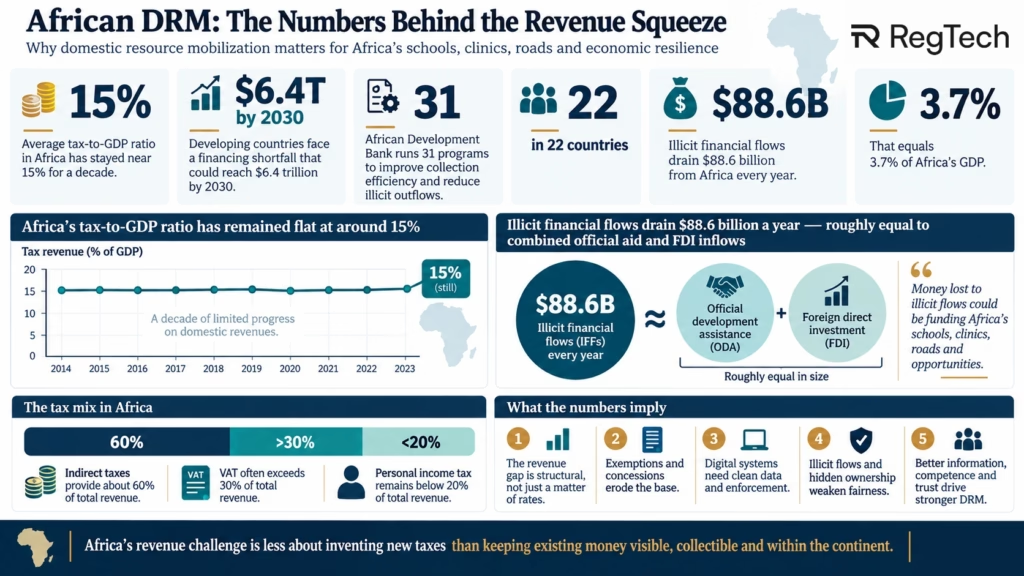
African governments confront the same awkward arithmetic every year. How to pay for schools, clinics, roads and a swelling workforce when tax receipts barely budge? The continent’s average tax-to-GDP ratio has lingered near 15 percent for a decade. Developing countries as a group face a financing shortfall that could hit $6.4 trillion by 2030. African states, which already pay higher borrowing costs than rich ones, feel the squeeze more keenly. The usual response is to hunt for fresh external money. A better first question is where the existing money goes. And there we get to the arithmetic of African DRM.
Interest bills in many countries now rival spending on health and education. Fiscal space, that polite phrase finance ministries reach for when little remains, is scarce. The African Development Bank has grown blunt about the remedy. Domestic revenue mobilization, it argues, emphasizes resilience, sovereignty and basic services.
At a ministerial gathering in Tangier, Kevin Chika Urama, the bank’s chief economist, laid out practical pillars: stronger tax policy and administration, simpler regimes and a broader base. The bank already runs 31 programs in 22 countries aimed at raising collection efficiency and stemming illicit outflows. Its ten-year strategy treats African DRM as a strategic lever, not a side project. Nevertheless, the numbers remain stubborn. Revenue has not kept pace with needs. The shortfall is structural, not merely a matter of ambition.
5 Key Takeaways on African DRM
1. The problem is structural, not simply low rates. Narrow bases, exemptions, informality and patchy enforcement leave most countries collecting far less than their potential.
2. Governments give away more than they often need to raise. Concessions and poorly tracked exemptions routinely absorb large shares of possible revenue. Cleaning the base frequently delivers more than another rate increase.
3. Digital tools work only when institutions can use them. E-invoicing and tax-management systems are spreading. Without clean registries, skilled officials and real enforcement, they merely digitize existing weaknesses.
4. Fair taxation requires visibility at the top. Profit shifting and unclear ownership remain major risks. Automatic information exchange and beneficial-ownership registers give African authorities a clearer view of capital once hidden offshore.
5. Strong systems rest on information, competence and trust. Consumption taxes will stay central. Better administration should gradually let income and property taxes do more. Success will favor countries that close loopholes and convince citizens the rules apply upward as well as downward.
Illicit Flows Drain African DRM
Illicit financial flows remove an estimated $88.6 billion from Africa each year, or 3.7 percent of GDP. That sum roughly matches the combined inflow of official aid and foreign direct investment. Tax evasion, customs fraud and aggressive avoidance turn public money into private flight.
Indirect taxes supply about 60 percent of total revenue; value-added tax alone often exceeds 30 percent. Personal income tax stays below 20 percent. When systems lean so heavily on consumption taxes, every leakage hits harder. Compliant firms and citizens shoulder more of the load while others slip away.
Digital business models, remote work and labyrinthine cross-border deals have made detection harder still. Many tax offices operate with thin staff, incomplete data and limited investigative reach. Layering new taxes onto weak systems often yields little extra cash while raising the burden on those already paying.
Non-Compliance and Illicit Activity Persists
Debate still fixates on inventing new taxes. A sharper test is whether existing ones are collected. Weak compliance leaves room for non-compliance and illicit activity to persist. Strengthening administration can therefore produce larger returns than fresh legislation alone.
Tax offices cannot tax income they cannot see, investigate assets whose owners stay hidden, or pursue claims that stop at the border without help. Information, compliance management, solid investigations and cross-border tools are therefore essential.
Initiatives such as the ATAF mutual-assistance agreement, exchange-of-information programs and beneficial-ownership registers are building those capabilities. The shift in thinking matters. Tackling illicit flows is no longer treated as a pure enforcement issue. It is recognized as a central part of African DRM and sustainable development.
What Are the Tech Limits?
Digital systems have expanded rapidly. Installation, however, is not administration. Data can sit unused. Mass registration can produce impressive lists of taxpayers who never file or pay. Local knowledge and experienced auditors still matter, but precise digital tools do make a real difference.
International transparency measures have raised the cost of secrecy. Automatic exchange of financial information and country-by-country reporting give authorities sight of profits and assets once reserved for banks and intermediaries. These tools do not erase capacity shortages. They do make progressive taxation more realistic once capital becomes harder to conceal. The political stakes are high. A system that tracks street vendors while missing the beneficial owners of large firms will struggle to look legitimate, however polished its software.
Trust as an Asset in African DRM
Tax reform is political economy conducted with spreadsheets. Governments can calculate expected yields to two decimal places and still lose the measure on the street. Compliance rises when citizens see concrete services nearby and believe others are paying their share. Arbitrary treatment, politically connected exemptions and leisurely pursuit of well-connected debtors erode that belief fast.
The resources needed to transform African economies may already exist inside the continent. The immediate task is to keep more of them there. Addressing illicit financial flows will not close every financing gap. Without addressing them, closing the gap becomes markedly harder.
African DRM in the years ahead will depend less on the highest headline rate than on better information, fewer needless exemptions, capable officials and enough public trust to enforce the rules consistently. That definition of state capacity is unglamorous. It is also the one most likely to pay for the schools, hospitals and infrastructure the continent requires.

We are here to help governments, financial institutions, and businesses to effectively comply with growing regulatory requirements through technology.