
A century ago, Sweden was still poor and rural. Its income per person, adjusted for purchasing power, was about $3,500, and tax revenue was below 10% of GDP. The World Bank notes that this is roughly where Togo finds itself today, except Togo already collects around 14% of GDP in tax. The awkward difference is time. Sweden had a century to build a richer economy and a larger state. Many developing countries are being asked to do the same fiscal work in a decade. That is the setting for Domestic Revenue Mobilization 2026.
Foreign aid from major donors fell by more than 23% in the latest year covered by the World Bank report, the largest decline on record. Debt burdens are high, interest bills are rising and public investment needs have hardly become cheaper. Yet tax revenue has barely moved since 2010: about 10% of GDP in low-income countries, 13% in lower-middle-income ones and 19% in upper-middle-income economies.
The central problem, then, is less a shortage of tax rates than a shortage of taxable reality that governments can reliably see, measure and collect. The next phase of revenue reform will be decided by whether states can widen effective tax bases, reduce privileges, make digital systems usable and persuade citizens that the rules apply upward as well as downward.
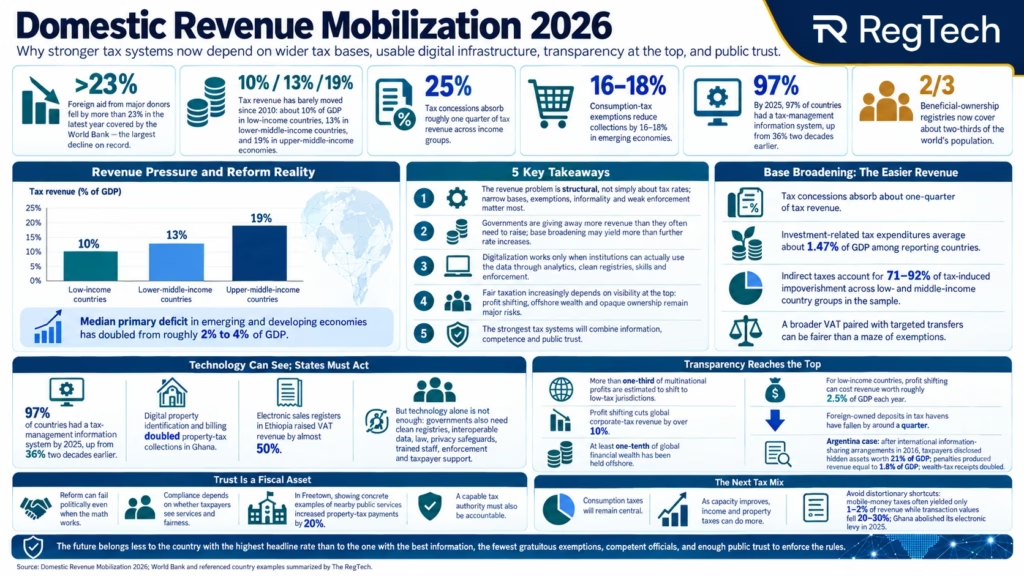
5 Key Takeaways on Domestic Revenue Mobilization in 2026
- The revenue problem is structural, not simply about tax rates. Many emerging markets already tax formal firms heavily. The bigger weakness is narrow tax bases, exemptions, informality and weak enforcement. Most countries still operate below their fiscal potential.
- Governments are giving away more revenue than they often need to raise. Tax concessions absorb roughly a quarter of tax revenue across income groups, while consumption-tax exemptions cut collections by 16–18% in emerging economies. Base broadening may offer more than another rate increase.
- Digitalization only works when institutions can use the data. E-invoicing, digital ID and tax-management systems are spreading fast, with striking gains in countries such as Ghana and Ethiopia. Yet technology without analytics, clean registries, skilled officials and enforcement can simply digitalize existing administrative weakness.
- Fair taxation increasingly depends on seeing wealth at the top. Profit shifting, offshore wealth and opaque ownership structures remain major revenue risks. Automatic information exchange and beneficial-ownership registries are making capital harder to hide and giving emerging markets a stronger basis for taxing high-income individuals and multinationals.
- The strongest tax systems will combine information, competence and trust. Consumption taxes will remain important, but better administration should allow greater use of income and property taxes over time. The countries that perform best will be those that resist distortionary shortcuts, improve transparency and convince taxpayers that the rules apply to everyone.
The Fiscal Arithmetic Is Worsening
The pressure is visible in the budget numbers. The median primary deficit in emerging-market and developing economies has doubled from roughly 2% of GDP around the turn of the century to 4%. In many countries, interest payments now exceed spending on health and education. Fiscal space has become the sort of phrase finance ministries use when there is very little of it left.
Higher statutory rates offer an obvious response, and often a poor one. Many emerging economies already tax formal firms at relatively high rates while collecting much less than richer countries. Narrow bases, exemptions, informality and weak enforcement do the damage. Corporate-tax burdens also vary sharply across sectors, directing capital toward tax-favoured activities rather than productive ones.
The World Bank’s useful idea is a “fiscal frontier”: the best combination of efficiency and fairness a country can achieve for a given level of revenue, given its institutions and economic structure. Most countries sit inside it. Even among those with stronger fundamentals, 66% are estimated to fall short; among weaker states, 73% do. That is encouraging in one sense. Governments can often improve revenue, fairness and efficiency together. It is also an indictment of how much existing tax capacity is wasted.
Domestic Revenue Mobilization 2026: The Base
The easiest revenue is frequently the revenue governments have chosen to give away. Tax concessions absorb roughly one-quarter of tax revenue across income groups. In emerging economies, consumption-tax exemptions alone reduce collections by 16-18% before any evasion occurs. Investment-related tax expenditures average about 1.47% of GDP among reporting countries.
Some concessions have a defensible purpose. Many do not. Reduced rates and bespoke exemptions are politically convenient because the cost is hidden inside the tax code rather than written as an expenditure line in the budget. They also create constituencies that become remarkably eloquent when reform is proposed. A finance minister hunting for revenue may find more in the annexes of the tax code than in a new tax bill.
The distributional case for cleaning up the base is strong. Emerging markets depend heavily on indirect taxes because transactions are easier to observe than income. Nevertheless, indirect taxes account for 71-92% of tax-induced impoverishment across low- and middle-income country groups in the report’s sample. Personal income taxes remain narrow and property taxes are often negligible. A broader VAT paired with targeted transfers can be fairer than a Swiss cheese of exemptions, while stronger income and property taxation can gradually shift more of the burden toward those able to pay.
Technology Can See; States Must Act
Tax administrations have digitalized at startling speed. By 2025, 97% of countries had a tax-management information system, up from 36% two decades earlier. E-filing, e-payments, digital identification and e-invoicing are spreading quickly. Some lower-income countries have moved faster on e-invoicing than rich ones, partly because they have more VAT leakage to attack and fewer legacy systems to defend.
The best results are substantial. Digital property identification and billing doubled property-tax collections in Ghana. Electronic sales registers in Ethiopia raised VAT revenue by almost 50%. Digital public infrastructure can give tax authorities something they have historically lacked: a reliable way to connect people, firms, assets and transactions.
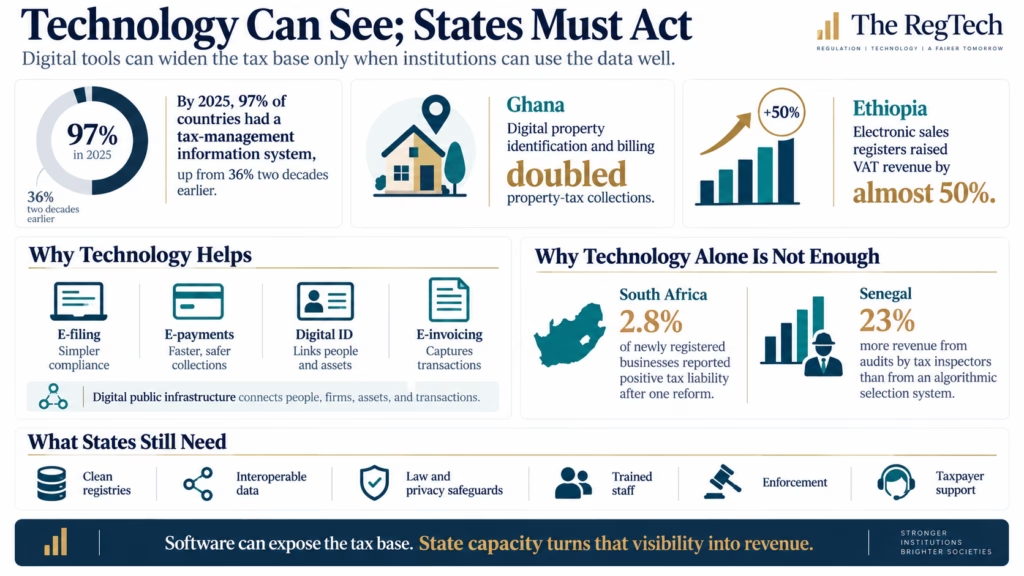
Still, installation is not administration. E-invoice data can sit untouched because nobody can analyze it. Mass registration can create impressive dashboards full of taxpayers who never file or pay. In South Africa, one study found that only 2.8% of newly registered businesses reported any positive tax liability during the six years after a reform. In Senegal, tax inspectors generated 23% more revenue from audits than an algorithmic selection system. Local knowledge still has market value.
The lesson is prosaic and therefore easy to ignore. Digital systems need clean registries, interoperable data, law, privacy safeguards, trained staff, enforcement and taxpayer support. Governments that buy software without these complements are buying a more expensive way to discover their old institutional problems.
Transparency Reaches the People At the Top
Domestic taxation increasingly runs into international geography. More than one-third of multinational profits have been estimated to shift to low-tax jurisdictions, cutting global corporate-tax revenue by over 10%. At least a tenth of global financial wealth has been held offshore. For low-income countries, the report estimates that profit shifting can cost revenue worth roughly 2.5% of GDP each year.
The past decade has made secrecy more expensive. Automatic exchange of financial information, beneficial-ownership registries and country-by-country reporting give tax authorities a view of assets and profits that was previously reserved for banks, accountants and the owners themselves. Beneficial-ownership registries now cover about two-thirds of the world’s population, while foreign-owned deposits in tax havens have fallen by around a quarter.
Argentina shows the scale of what visibility can reveal. After adopting international information-sharing arrangements in 2016, taxpayers disclosed previously hidden assets worth 21% of GDP. Penalties produced revenue equal to 1.8% of GDP and wealth-tax receipts doubled. This is not a template that can simply be copied. It does show that progressive taxation becomes more plausible when capital is harder to hide.
For emerging markets, this matters politically as well as fiscally. A tax system that can track a street vendor’s mobile payment but cannot identify the beneficial owner of a large company will struggle to look fair, however sophisticated its servers are.
Domestic Revenue Mobilization 2026: Trust Is a Fiscal Asset
Tax reform is an exercise in political economy conducted with spreadsheets. Governments may calculate the yield from a tax change to the second decimal place and still lose the reform in the street. Malaysia repealed its goods and services tax in 2018. Jordan revised an income-tax reform after protests the same year. Kenya withdrew its Finance Bill in 2024, and the Dominican Republic also withdrew a tax-modernization proposal.
Compliance depends partly on what taxpayers believe they receive and what they believe others are paying. In Freetown, showing property owners concrete examples of nearby public services increased property-tax payments by 20%. The result is modest compared with the rhetoric surrounding “tax morale”, which is probably healthy. Trust is usually built through repeated evidence rather than slogans.
This also sets limits on enforcement. Citizens notice arbitrary treatment, corruption and politically connected exemptions. They notice when the tax authority can pursue a small shop quickly and a well-connected debtor slowly. Technology can reduce discretion, yet unclear algorithms and poor data governance can create a new version of the same problem. A revenue authority that becomes more capable without becoming more accountable may collect more for a while. It is unlikely to make reform durable.
The Next Tax Mix
Domestic Revenue Mobilization in 2026 will increasingly be shaped by a paradox of digitalization. Transactions are becoming easier to trace just as profits, intellectual property and high-end capital income become easier to move. Artificial intelligence may deepen both trends. More commerce will leave electronic records. More value may accrue to intangible assets that can be booked somewhere else.
That suggests a gradual shift in the tax mix rather than a grand redesign. Consumption taxes will remain central because they are administratively productive. Their regressive effects can be offset more cleanly with targeted transfers than with proliferating reduced rates. As administrative capacity improves, income and property taxes can do more. International coordination will matter more for corporate and capital income.
Governments should also resist seductive shortcuts. Mobile-money taxes have typically yielded only 1-2% of total tax revenue in countries such as Ghana, Kenya, Nigeria and Uganda, while transaction values fell by 20-30% after their introduction across several cases. Ghana eventually abolished its electronic levy in 2025. Taxing the rails of digitalization can raise cash today while making tomorrow’s tax base harder to observe.
The future therefore belongs less to the country with the highest headline rate than to the one with the best information, the fewest gratuitous exemptions, competent officials and enough public trust to enforce the rules. That is an unglamorous definition of state capacity. It is also the one most likely to pay the bills.

Founder of The RegTech, focused on inclusive digital policies and scalable solutions through multilateral collaboration for global governance and development.