

The narrative of the Asia and Pacific region growth over the past three decades has been one of unrivalled economic ascendancy. It is a story of structural transformation that lifted hundreds of millions from poverty, doubled GDP per capita, and turned the region into the world’s manufacturing heartland. This remarkable trajectory, however, is now intersecting with a complex web of megatrends that will define its next chapter.
As the International Monetary Fund and World Bank prepare to convene their Annual Meetings in Bangkok mid-October, the discourse must pivot from celebrating past achievements to going through a future fraught with demographic headwinds, technological disruption, and geopolitical fragmentation. The central question is no longer whether the region can grow, but whether it can reinvent its growth model with the sophistication and speed the moment demands. For the RegTech sector, this is not merely an opportunity; it is an imperative.
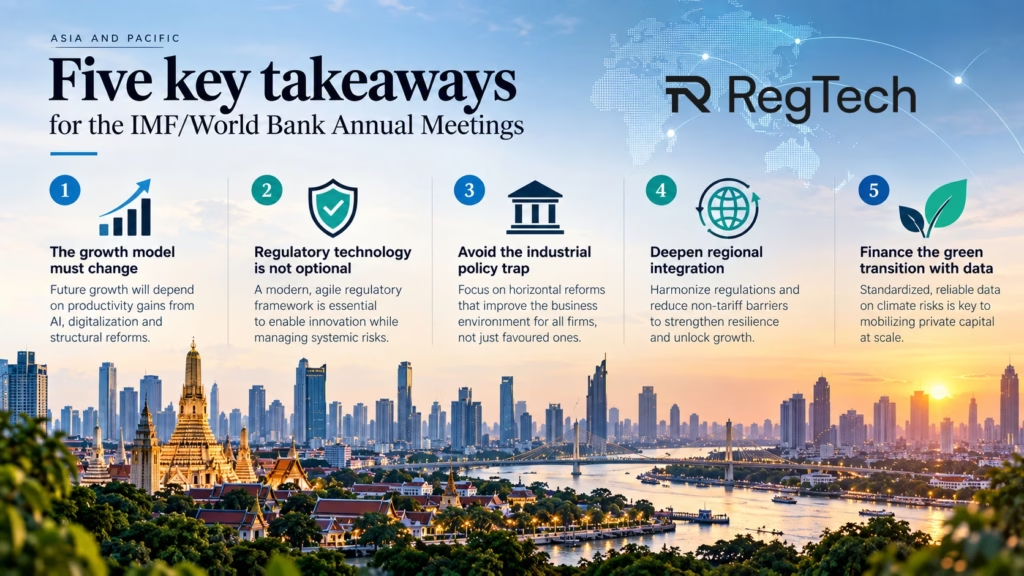
5 Key Takeaways for the IMF/World Bank Annual Meetings
- The Growth Model Must Change: The era of demographic dividends and export-led manufacturing is waning. Future Asia and Pacific growth will depend on productivity gains from AI, digitalization, and structural reforms.
- Regulatory Technology is Not Optional: The safe and equitable adoption of AI and digital finance requires a modern, agile regulatory framework. Regulatory technology is the infrastructure that enables innovation while managing systemic risks.
- Avoid the Industrial Policy Trap: Evidence shows that most industrial policies have limited, short-lived effects. The focus must be on horizontal reforms that improve the business environment for all firms, not just favoured ones.
- Deepen Regional Integration: With global trade fragmenting, deeper intraregional integration is a crucial buffer. This requires harmonizing regulations and reducing non-tariff barriers, tasks that demand sophisticated compliance solutions.
- Finance the Green Transition with Data: Mobilizing capital for climate adaptation and mitigation requires transparent, standardized data on climate risks. Regulatory tech provides the tools to generate this data and build investor trust.
The Productivity Paradox and the Fading Demographic Dividend
For decades, Asia and Pacific growth was powered by an almost mechanical formula: shift labour from low-productivity agriculture into higher-productivity manufacturing, invest heavily in capital, and integrate deeply into global supply chains. This engine, however, is sputtering. Productivity gains that once fuelled rapid expansion have slowed virtually everywhere since the 2008 global financial crisis. More concerning is the finding that capital efficiency is declining. Growing misallocation of resources towards less productive firms and state-owned enterprises is evident. The region’s investment-to-GDP ratio remains a hefty 27 percent, yet the returns on that investment are diminishing.
Simultaneously, the demographic tailwind that provided a seemingly endless supply of young workers is turning into a headwind. Fertility rates have plummeted from six children per woman in 1965 to just 1.6 in 2026. This is well below the replacement rate. The working-age populations in China, Japan, and Korea are already shrinking. By 2050, the share of the population aged 65 and over in the region will surge to 20 percent. The old-age dependency ratio is set to double, surpassing that of Africa or the Middle East. This is not a distant threat; it is a present reality. The traditional engines of demographic dividends and export-driven manufacturing are losing momentum.No amount of legacy policy can restart them.
Asia and Pacific Growth: AI, Fintech, and the New Infrastructure
Into this void steps a new set of growth drivers: digitalization and artificial intelligence. These are not mere add-ons to the old economy; they are general-purpose technologies capable of rewriting the rules of production. Model-based simulations suggest that AI adoption could boost annual growth by 0.2 to 0.8 percentage points in emerging and developing economies in the region, and up to 1 percentage point in advanced ones. Japan is leveraging AI in robotics to sustain productivity amid a shrinking workforce. Korea is a leader in AI adoption in manufacturing; India is rapidly becoming a global hub for financial technology.
Yet, the adoption of these technologies will be profoundly uneven. Advanced economies like Japan, Korea, and Singapore are structurally prepared for early AI adoption. Conversely, emerging markets like Bangladesh, Thailand, and Vietnam risk being left behind. This is due to lower skill levels and weaker capital intensity. This divergence is not just an economic concern; it is a stability risk. Uneven exposure to AI also threatens to widen income inequality within countries, as high-skilled workers in AI-complementary roles reap wage gains while low- and medium-skilled workers face displacement.
This is where the regulatory technology, or The RegTech, becomes indispensable. The rapid, safe, and equitable adoption of AI, digital finance and taxation hinges on a foundation of trust. The region’s digital payment networks, from India’s Unified Payments Interface to ASEAN’s cross-border QR code linkages, are generating unprecedented volumes of transaction data. This data, if properly harnessed, can unlock access to credit for underserved small firms, reduce information asymmetries, and dramatically improve the efficiency of cross-border transactions. But it also creates new vectors for fraud, cyber-attacks, and money laundering. We see the regulatory technology as the essential infrastructure for managing these risks. It is guaranteeing that innovation does not outpace the safeguards needed to protect the financial system and its users.
Geoeconomic Fragmentation and the Industrial Policy Trap
At this point, the external environment is no longer as welcoming as it once was. Geoeconomic fragmentation is reshaping trade patterns and supply chains. The US-China trade tensions and the tariff shocks of 2025 have disproportionately affected the Asia and Pacific region, given its high trade openness. The region has scope to strengthen intraregional integration. The share of intraregional trade in final goods remains below 30 percent, versus 60 percent in European and North American blocs. Deeper regional integration could raise the region’s real GDP by about 1.8 percent in the long term. However, this requires regulatory harmonization and the removal of non-tariff barriers. Which is a complex task that demands sophisticated compliance and reporting mechanisms.
In response to these pressures, many governments are turning to industrial policy. The region has seen a significant increase in vertical interventions like subsidies, export promotion, and local content requirements since 2009. Yet the evidence on their effectiveness is sobering. The positive effects of industrial policies generally dissipate within a few years, and they rarely translate into sustained industrial competitiveness. Domestic subsidies often reinforce existing advantages rather than creating new ones, and import-limiting measures rarely lead to lasting productivity gains. The fiscal costs are substantial, and the risk of rent-seeking is ever-present. The policy agenda must resist the siren song of easy protectionism. Focus should be on horizontal structural reforms: improving education, strengthening institutions, and creating a level playing field for private enterprise.
Asia and Pacific Growth: The Green Transition and the Data Challenge
The transition to a sustainable future is another megatrend that will reshape the regional economy. Asia and Pacific is both a powerhouse for global growth and a large greenhouse gas emitter, heavily reliant on coal. It also faces acute climate vulnerabilities. From rising sea levels that threaten Bangkok and Ho Chi Minh City to extreme heat that reduces labour productivity, threats are there. The green transition is imperative, and it offers substantial economic opportunities in renewable energy, electric vehicle manufacturing, and climate-resilient infrastructure. China leads the world in solar panel and wind turbine production. India on the other side, has one of the most ambitious renewable energy expansion plans.
Financing this transition, however, is a monumental challenge. Mobilizing private capital requires a vigorous pipeline of investable projects and adequate risk-sharing mechanisms. Basically, a key barrier is the lack of reliable, comparable data on climate risks and the environmental impact of investments. This is a classic regtech problem. Certainly, standardized reporting frameworks, automated data collection, and AI-driven analytics are needed to give investors the confidence to deploy capital at scale. Without this regulatory technology backbone, the green transition will remain a promise unfulfilled.
As the region’s policymakers, business leaders, and financiers gather in Bangkok, we see that Asia and Pacific growth story is far from over. Next chapter will be written by those who can master the complex interplay of demographics, technology, and geopolitics. The path forward is not through nostalgia for a bygone era of easy growth, but through a proactive embrace of the regulatory and technological innovations that will define the future economy. The RegTech as a company based in Asia and focused on supporting the countries of the developing world, with its unique ability to bridge the gap between innovation and stability, is poised to be a critical partner of local governments in this journey.

We are here to help governments, financial institutions, and businesses to effectively comply with growing regulatory requirements through technology.