
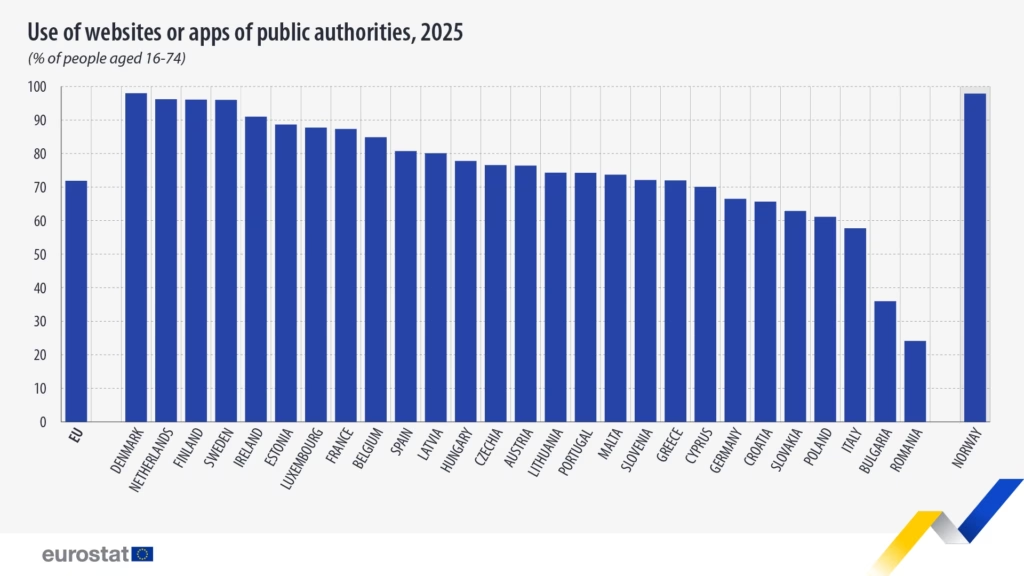
In 2025, digital public services have become routine for most Europeans. Yet the latest Eurostat data reveal a bloc split down the middle. While citizens in the north log on for everything from tax returns to doctor’s appointments, large parts of southern and eastern Europe remain largely offline when dealing with the state. This uneven embrace of EU eGovernment Services is not just a matter of convenience. It is testing the European Commission’s 2030 goal of making every key public service fully available online and giving every citizen a workable electronic identity.
The numbers tell a clear story. Across the EU, 72 percent of people aged 16 to 74 used a government website or app in the past year. In Denmark the share reached 98 percent, matched almost exactly by Norway. The Netherlands, Finland and Sweden each hit 96 percent, while France came in at 91 percent. By contrast, only 36 percent of Bulgarians and 24 percent of Romanians did the same. The gap is not small. It separates countries where public administration has moved almost entirely online from those where paper forms and in-person queues remain the norm.
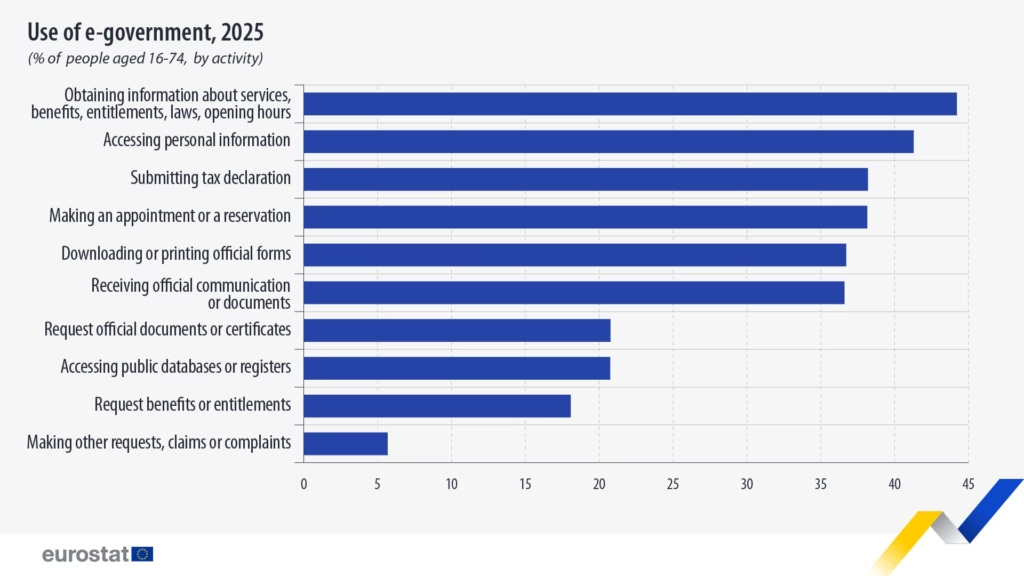
These differences matter for everyday efficiency. Citizens who use EU eGovernment Services most often seek information about benefits or opening hours (44 percent). Almost as many check personal records (41 percent) or file taxes and book appointments (both 38 percent). Compared with 2022, every major activity has grown except the downloading of printable forms, which fell from 44 percent to 37 percent. The shift points to a change: Europeans are moving from half-digital processes to fully online ones, at least where the infrastructure exists.
5 Key Takeaways
- Nordic and Baltic leaders dominate adoption: Denmark (98%), the Netherlands, Finland and Sweden (all 96%) lead EU eGovernment Services usage, with France close behind at 91%. In sharp contrast, Bulgaria (36%) and Romania (24%) lag far behind, highlighting a persistent two-speed Europe in digital public administration.
- eID remains underused outside high-trust nations: Only 52% of EU citizens used electronic identification in 2025. Uptake exceeds 90% in Denmark (99%), Finland, the Netherlands, Sweden and Estonia, but stays below 15% in Germany, Slovakia, Bulgaria and Romania. Norway demonstrates what strong political and technical commitment can achieve at 96%.
- Working-age adults drive eID usage: People aged 35-44 and 25-34 show the highest adoption rates (both 61%), compared with just 36% among those 65-74. This pattern underscores that EU eGovernment Services appeal most to citizens managing taxes, benefits and appointments rather than the youngest or oldest groups.
- Cross-border eID use stays limited despite eIDAS rules: Only 9% of EU citizens used their eID for services in another member state. Denmark leads dramatically at 80%, while the EU average remains low. Most citizens still confine digital interactions to their home country, limiting the single market potential of electronic identities.
- Private-sector spillover shows long-term promise: In Estonia (81%), Finland (80%) and Sweden (73%), citizens readily use eID for business services, well above the EU average of 25%. This suggests that successful government digital identity systems quickly extend into banking, insurance and commerce, accelerating broader digital transformation.
EU eGovernment Services 2025: Widespread Uptake, Patchy Progress
National patterns dominate the picture of EU eGovernment Services. The five leading countries have spent years investing in user-friendly portals and high-speed broadband that reaches even remote places. Their citizens expect services to work on a smartphone. In Bulgaria and Romania, the opposite holds. Lower broadband penetration, fewer public campaigns and lingering distrust of digital systems keep usage low. The result is a two-speed Europe in which northern civil servants process cases faster and at lower cost while southern and eastern ones still rely on manual paperwork.
The data also hint at changing habits. The drop in printed forms suggests many users now complete transactions end-to-end online rather than printing and posting documents. That trend saves governments money and cuts waiting times. Yet it also risks leaving behind those without reliable internet or the skills to navigate complex portals. Policymakers in Brussels have noticed. The Digital Decade programme sets a hard target: by 2030 every major public service must be reachable via the internet. Current figures show the EU is on track in the north but faces a steep climb in the south-east.
Electronic IDs: The Digital Passport Still Waiting for Users
Electronic identification is the secure key that unlocks EU eGovernment Services. In 2025, 52 percent of EU adults used their eID at least once in the previous year for private purposes. Again, the north leads decisively. Denmark recorded 99 percent uptake, Finland 96 percent, the Netherlands 95 percent, Sweden 92 percent and Estonia 91 percent. Germany managed just 15 percent, Slovakia 14 percent, Bulgaria 12 percent and Romania 10 percent. Norway, though outside the EU, reached 96 percent and showed what is possible when political will meets technical readiness.
Age adds another layer. Working-age adults drive adoption. Among those aged 35-44 and 25-34, 61 percent used eID. The 45-54 group followed at 56 percent. Younger people aged 16-24 came in at 50 percent, while only 36 percent of those 65-74 did so. The pattern is unusual. For most online activities the young lead; here the peak sits firmly among people juggling jobs, families and taxes. Older citizens lag, often because they prefer familiar face-to-face contact or struggle with the technology.
Cross-Border Reach and Private-Sector Take-Up
The eIDAS Regulation requires member states to recognise each other’s notified electronic identities. In practice, cross-border use remains rare. Only 9 percent of EU citizens employed their eID to access services in another member state last year. Denmark stood out at 80 percent, followed by Luxembourg at 25 percent and Sweden at 23 percent. Most people still limit their digital dealings to their home country.
Private-sector use tells a different story. In Estonia 81 percent of eID holders logged into business services, followed by Finland at 80 percent and Sweden at 73 percent. The EU average was 25 percent. These figures show that once citizens master the technology for government, they quickly apply it to banking, insurance or other commercial platforms. Estonia’s success is instructive. Its long-standing digital-ID system has become part of daily life, blurring the line between public and private transactions.
EU eGovernment Services: The Road to 2030
The Eurostat survey, conducted annually in the second quarter and covering the previous 12 months, provides the most reliable yardstick for the EU’s digital ambitions. It tracks the same core indicators over time, allowing clear year-on-year comparisons. The module on e-government has run every year since a 2022 revision; eID questions appear every two years. The data feed directly into the four pillars of the Digital Compass: skills, business transformation, infrastructure and public-service digitisation.
Reaching the 2030 targets will require more than new laws. Countries with low uptake must close the infrastructure gap, run sustained awareness campaigns and simplify interfaces. High-trust societies such as the Nordics have shown the way. Their citizens use EU eGovernment Services not because they are forced to, but because the services are faster, safer and more convenient than the old methods. The rest of the continent must now decide whether to follow or risk falling further behind in the race to build a truly digital single market.

We are here to help governments, financial institutions, and businesses to effectively comply with growing regulatory requirements through technology.