
The UN eGovernment index 2026 arrives at a particularly revealing moment in the history of public administration. Governments have spent much of the past quarter-century building digital institutions, connecting public services and making everyday administrative procedures accessible online. Their achievements have fundamentally altered the relationship between citizens and the state. The latest United Nations assessment suggests that the transformation is gathering pace.
Published on 19 November 2026, the United Nations E-Government Survey, From Digital Government to Agentic Government, examines 194 countries, including the State of Palestine for the first time. Its findings document considerable improvements in digital government capabilities, alongside persistent inequalities in infrastructure, education and institutional capacity.
Two years ago, our examination of the 2024 UN E-Government Survey considered the difficult road facing developing nations. The central concerns were connectivity, access to technology, public investment and the widening distance between digitally advanced societies and those struggling to establish essential infrastructure. These questions remain relevant, although the international landscape has changed appreciably.
The 2026 edition introduces an additional dimension. Artificial intelligence is beginning to influence how public institutions organize their work, interpret information and respond to citizens’ needs. The United Nations now invites governments to consider the emergence of Agentic Government, a model in which intelligent systems could eventually coordinate administrative functions with increasing operational autonomy. The implications extend into public accountability, democratic legitimacy and the future organization of the state itself.
UN eGovernment Index 2026: Five Key Takeaways
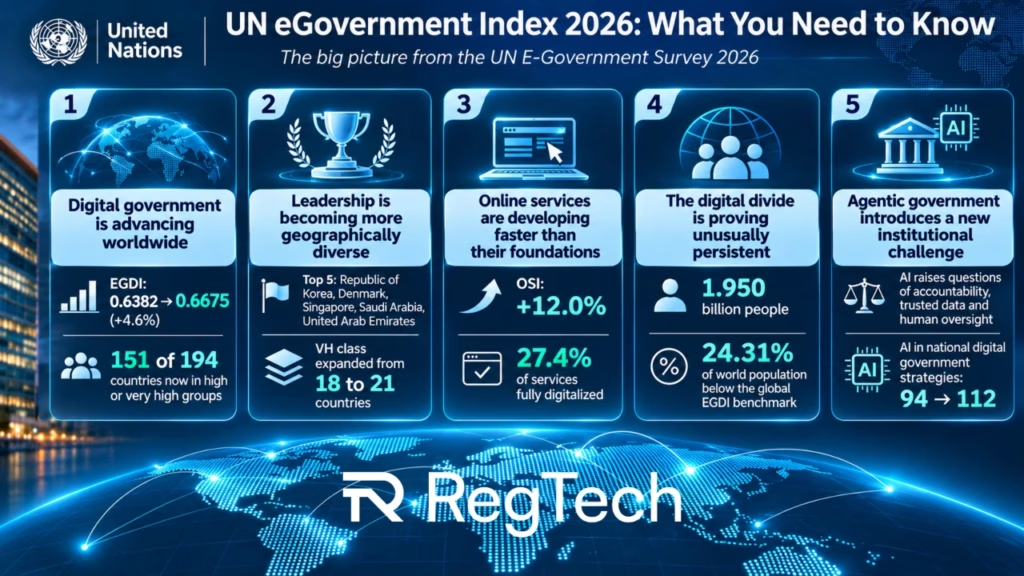
1. Digital government is advancing across the world. The global E-Government Development Index (EGDI) rose from 0.6382 in 2024 to 0.6675 in 2026. Some 151 countries now occupy the high or very high development groups, an increase from 138 two years earlier.
2. Leadership is becoming more geographically diverse. The Republic of Korea leads the international ranking, followed by Denmark and Singapore. Saudi Arabia and the United Arab Emirates complete the top five, illustrating the growing prominence of Western Asia in digital government development.
3. Online services are developing faster than their foundations. The Online Service Index increased by 12%, considerably outpacing telecommunications infrastructure and human capital. Only 27.4% of assessed public services have achieved full digitalization.
4. The digital divide is proving unusually persistent. Approximately 1.95 billion people live in countries whose EGDI scores remain below the global average. Africa faces the deepest population-weighted disparity, even as several African governments record impressive improvements.
5. Agentic Government introduces a new institutional challenge. AI could make public administration more responsive and capable of coordinating complex services. Its responsible adoption will require secure infrastructure, reliable data, enforceable safeguards and institutions capable of retaining meaningful human control.
Twenty-Five Years of Measuring Digital Government
The United Nations began assessing electronic government development in 2001, when digital public administration was still an emerging ambition. Internet access was limited, mobile connectivity remained relatively primitive, and online government services were frequently little more than electronic noticeboards.
The intervening years have transformed public expectations. Digital identification, online payments, electronic procurement, government portals and interconnected databases now form part of the administrative landscape in numerous countries. Activities that previously required several visits to public offices can increasingly be completed from a mobile phone.
The UN eGovernment index 2026 captures this transformation through three dimensions: the Online Service Index, the Telecommunication Infrastructure Index and the Human Capital Index. Together, they measure the scope and quality of online services, the infrastructure that supports them and the human capabilities necessary to use them.
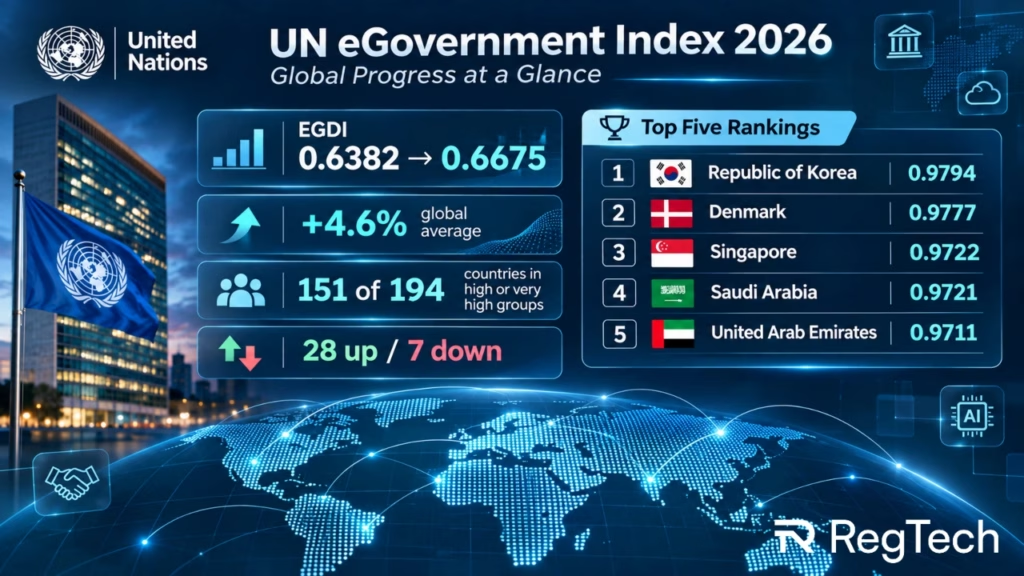
The global average EGDI increased by 4.6% between 2024 and 2026. More significantly, the median rose from 0.6678 to 0.6880, demonstrating improvement across a substantial portion of the international distribution. Among the 35 countries that changed development groups, 28 advanced and seven moved downward. Nevertheless, ten countries remain in the lowest category, reminding policymakers of the considerable difficulties facing states with persistent structural disadvantages.
UN eGovernment Index 2026: A More Competitive Map
The Republic of Korea occupies first place in the 2026 ranking, with an EGDI score of 0.9794. Denmark follows at 0.9777, while Singapore achieves 0.9722. Their positions reflect sustained investment in public-sector capabilities, digital infrastructure and integrated service delivery.
Saudi Arabia ranks fourth with 0.9721, narrowly ahead of the United Arab Emirates at 0.9711. Iceland, the United Kingdom, Estonia, Finland and Australia complete the global top ten. The increasingly varied composition of this leading group illustrates how digital government expertise has developed across distinct political, economic and administrative environments.
The Survey’s highest-performing rating class, designated VH, has expanded from 18 to 21 countries. Kazakhstan, Ireland and Poland enter this elite category for the first time, while the United States returns. The broader very high EGDI development group now contains 84 countries, compared with 76 in 2024.
These results deserve attention beyond their competitive appeal. Countries with relatively different institutional traditions have demonstrated an ability to develop sophisticated digital government systems. Their experiences offer opportunities for comparative research into administrative coordination, procurement practices, institutional leadership and the long-term financing of digital public infrastructure.
Online Public Services Are Expanding at Remarkable Speed
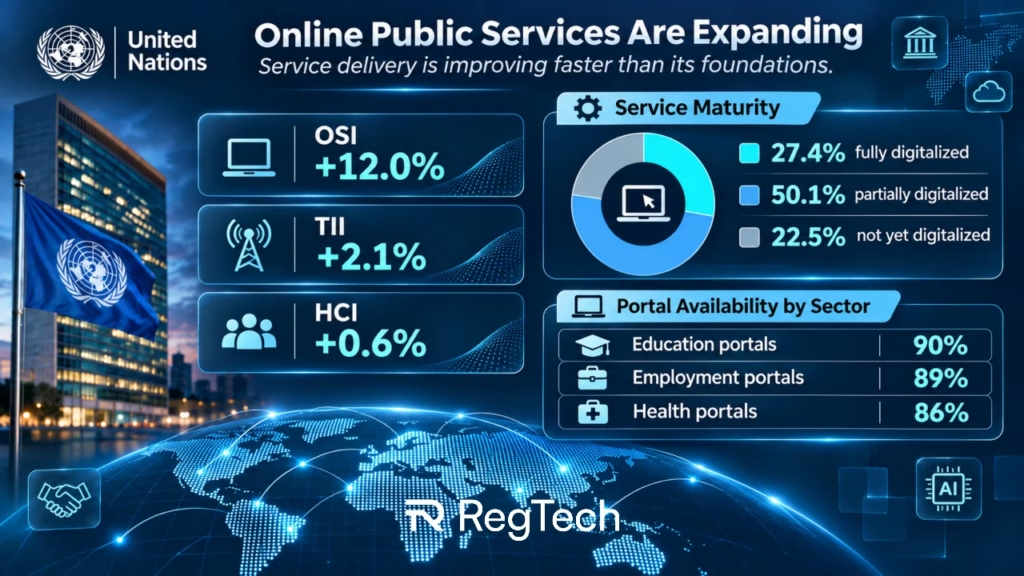
Perhaps the most consequential finding in the UN eGovernment index 2026 concerns the pace of online service development. The average Online Service Index increased by 12% over two years, compared with 2.1% growth in telecommunications infrastructure and 0.6% in human capital.
Governments are making more administrative functions accessible electronically. Approximately four in five now organize digital services around significant life events, including education, employment, healthcare, housing and other circumstances that require interaction with multiple public institutions.
Education portals are available in 90% of assessed countries. Employment-related platforms reach 89%, while health portals are present in 86%. Open government data portals are reported in 87.6% of countries, indicating the increasingly prominent role of public information in national digital strategies.
The next challenge concerns the depth of these services. Of the 72 services evaluated across 194 countries, 27.4% are fully digitalized, 50.1% are partially digitalized and 22.5% remain undigitalized. Many governments have established substantial online service portfolios, although completing a procedure from beginning to end still frequently requires additional steps outside the digital environment.
The Unfinished Business of End-to-End Digitalization
For citizens, the quality of digital government is ultimately determined by the administrative experience. A service may appear on a national portal, offer detailed instructions and accept electronic applications, yet still require personal attendance, printed documentation or manual intervention before completion.
This distinction has considerable consequences. Each additional interaction imposes costs on individuals and businesses. Travel, waiting periods, repeated submissions and administrative uncertainty can reduce the practical value of an otherwise useful electronic service.
Business-related services demonstrate relatively advanced digital maturity. According to the Survey, 46% are fully digitalized and another 44% partially digitalized. This suggests that governments have devoted substantial attention to administrative processes associated with establishing and operating businesses.
The wider public-service environment remains less developed. Successful transformation requires agencies to exchange information reliably, recognize digital identities, accept electronic evidence and coordinate decisions. Achieving this level of integration demands changes to internal procedures, legal frameworks and institutional responsibilities. The visible interface represents only one part of a much larger administrative system.
Public Participation Remains an Unresolved Ambition
Digital government has always carried a democratic promise. Easier access to public information can improve transparency, while electronic communication creates opportunities for citizens to participate in decisions affecting their communities.
The 2026 Survey examines these capabilities through its Participation and Engagement indicators. Governments increasingly provide feedback mechanisms, consultation platforms and online channels through which citizens can communicate with public institutions.
However, the quality and influence of participation remain uneven. Access to a consultation platform offers limited democratic value when citizens cannot determine how their contributions are considered or whether public authorities respond to the concerns raised.
Meaningful participation therefore requires clear procedures, transparent reporting and institutional responsibility. Governments must explain how consultations influence policy, provide opportunities for public scrutiny and maintain accessible channels for people with limited digital skills. The maturity of digital democracy will depend increasingly on these administrative practices.
Africa: Encouraging Progress Beneath Persistent Structural Constraints
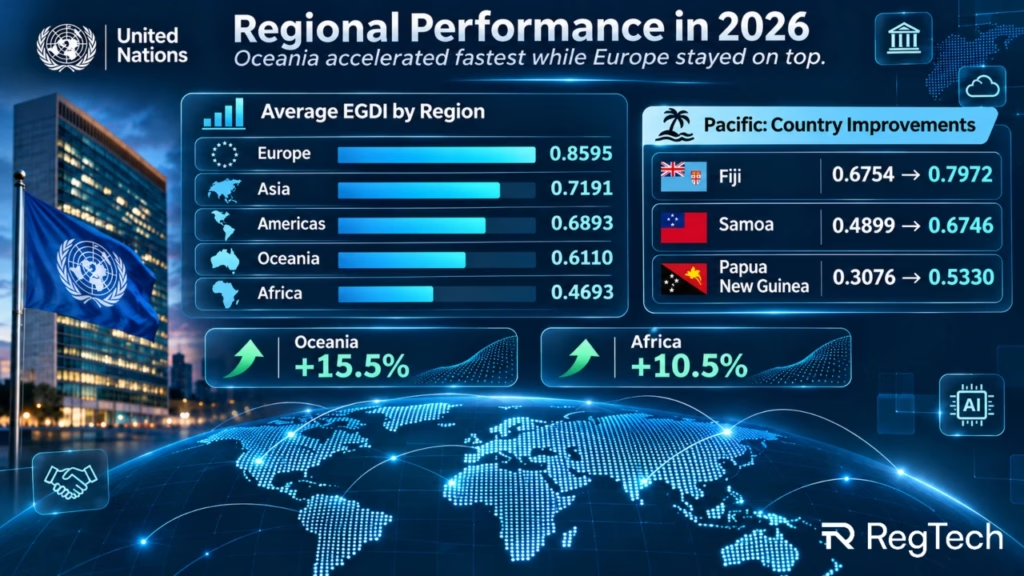
Africa records the second-fastest regional improvement in the 2026 Survey. Its average EGDI increased by 10.5%, reaching 0.4693. The advance reflects growing investment in connectivity, digital public infrastructure and electronic public services across a widening range of countries.
South Africa remains the continent’s highest-ranked country, occupying 52nd place globally with an EGDI of 0.8379. Morocco follows among the regional leaders at 0.7350, with Mauritius at 0.7226 and Tunisia at 0.7086.
Several countries have made particularly important advances. Zimbabwe, Cameroon, Nigeria, Benin, Togo and Uganda moved from the middle to the high EGDI group. Burundi and Niger, previously among the countries facing the greatest digital-government challenges, progressed from the low to the middle group.
These developments provide evidence of institutional movement across parts of the continent. Nevertheless, regional differences in online service provision and human capital have widened. Expanding infrastructure must be accompanied by investment in public-sector expertise, local-language accessibility, cybersecurity and administrative capacity. The long-term value of Africa’s digital transformation will depend on governments’ ability to maintain and improve the systems they establish.
Oceania: The Pacific Islands Emerge as the Survey’s Surprise Story
Oceania records the strongest improvement of any region, with average EGDI growth of approximately 15.5%. Much of this acceleration originates in Pacific Island countries that have historically faced severe geographic, financial and infrastructural disadvantages.
Fiji provides a particularly significant example. Its EGDI increased from 0.6754 in 2024 to 0.7972 in 2026, placing the country 66th globally and moving it into the very high development group. The Survey identifies the digitalFIJI programme and the country’s National Digital Strategy 2025–2030 among the developments associated with its progress.
Samoa advanced from 0.4899 to 0.6746, entering the high development group. Papua New Guinea improved from 0.3076 to 0.5330. Tuvalu, the Marshall Islands and Nauru also entered the high category, demonstrating that progress extends across several island economies.
The Survey also records increased online service availability in Tonga, alongside cybersecurity training for public officials. These examples illustrate the contribution of national digital strategies, targeted investment and international cooperation. Maintaining progress will require resilient connectivity, sustainable operating budgets and qualified personnel capable of supporting essential systems over time.
Europe, Asia and the Americas: Different Stages of Maturity
Europe retains its position as the most advanced region, with an average EGDI of 0.8595. The number of countries in its very high development group increased from 36 to 41. North Macedonia, Montenegro, Belarus, Monaco and Andorra moved into this category, illustrating progress beyond the region’s traditional leaders.
Asia ranks second regionally at 0.7191. It contains several of the world’s leading digital governments, including the Republic of Korea, Singapore, Saudi Arabia and the United Arab Emirates. India and Kyrgyzstan entered the very high EGDI group, demonstrating the expanding geographical reach of advanced digital government capabilities.
The Americas achieved an average EGDI of 0.6893. Trinidad and Tobago, the Dominican Republic and Saint Kitts and Nevis advanced into the very high group. Cuba and Belize moved into the high category. Mexico and Venezuela, however, moved to lower groups, reflecting different national development trajectories.
These results illustrate the growing importance of country-specific analysis. Regional averages provide useful benchmarks, yet they can conceal substantial differences in institutional capability and service maturity. A country’s administrative organization, fiscal resources, infrastructure and political priorities all influence its development trajectory.
UN eGovernment Index 2026: Digital Divide Has Changed
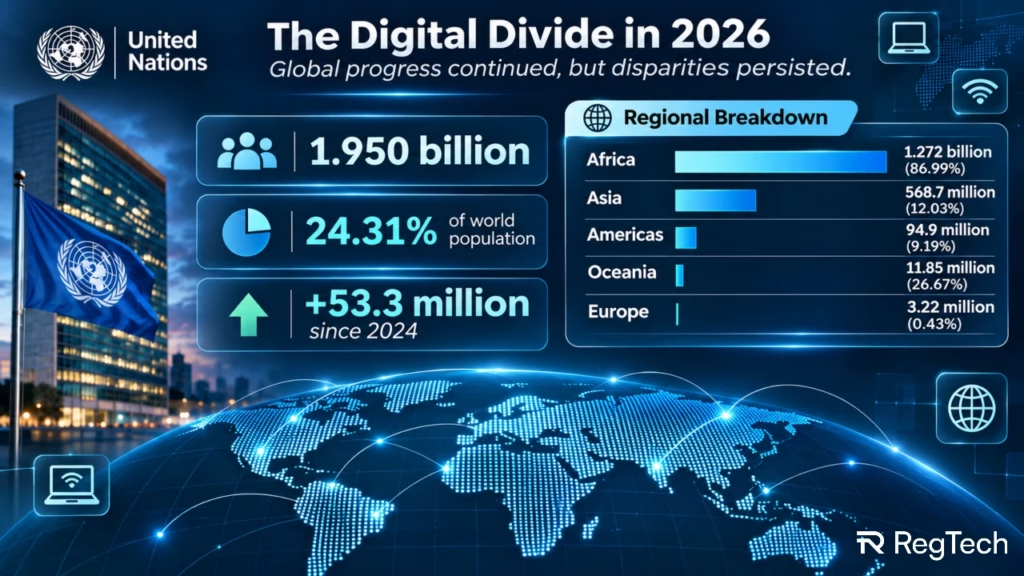
The UN eGovernment index 2026 places renewed attention on the population-weighted digital divide. Approximately 1.95 billion people, representing 24.31% of the world’s population, live in countries whose EGDI values fall below the global average.
In 2024, the corresponding figure was 1.897 billion, or 23.68%. The increase amounts to approximately 53.3 million people. This measure requires careful interpretation because the global average also increased. Countries can improve their digital capabilities and still remain below a benchmark that continues to rise.
The regional distribution is particularly revealing. Around 87% of Africa’s population lives in countries below the global EGDI average. In Oceania, significant improvements among Pacific Island states coexist with substantial differences between those countries and the region’s two established leaders, Australia and New Zealand.
These figures measure national digital-government performance relative to the international average. They do not identify individuals who lack internet access or cannot use public services. Nevertheless, they reveal a persistent development challenge: as governments become more sophisticated, countries with limited resources must continually increase their capabilities to prevent further relative disadvantage.
Connectivity, Affordability and Human Capital Determine Access
The expansion of digital government creates new opportunities for economic participation and public-service delivery. Their practical value depends heavily on whether citizens can afford connectivity and possess the skills needed to use electronic services.
Globally, mobile cellular subscriptions increased by 13.8% between survey editions, while internet use rose by only 1.1%. The Survey also identifies declining internet-use indicators in several developing-country groupings, demonstrating the uneven relationship between telecommunications expansion and actual connectivity.
Affordability remains especially problematic in structurally disadvantaged economies. Among countries classified simultaneously as least developed and landlocked, the cost of a mobile data and voice basket reached 18% of gross national income per capita. This is nine times the international affordability threshold of 2%.
Human capital presents an equally demanding challenge. Low-income countries recorded substantial improvements in online services and telecommunications infrastructure, although their average Human Capital Index declined by 5.3%. Digital literacy, education and accessible support services will determine whether increasingly sophisticated public platforms reach the populations they are intended to serve.
UN eGovernment Index 2026: Digital Inclusion Requires Attention
The 2026 Survey assesses dedicated online services for six population groups facing potential disadvantages: people living in poverty, migrants, women, young people, older persons and people with disabilities.
Across these categories, the availability of services expanded by an average of approximately 20%. The largest increase, 30%, concerned services for people living in poverty. Services for migrants also improved, increasing by 17.7%.
Yet important shortcomings persist. Migrants remain the least-served population group examined, with 166 countries providing dedicated online services and 28 offering none. Across vulnerable population groups, only around 30% of assessed services are fully digitalized.
Accessibility therefore deserves a central place in national digital strategies. Multilingual services, assisted digital channels, accessible interfaces and straightforward administrative procedures can determine whether citizens obtain the assistance to which they are entitled. Governments must assess these experiences through actual service use, with particular attention to people whose circumstances make digital interaction difficult.
Local Government: Where Digital Ambitions Meet Daily Life
National digital strategies influence the development of public administration, yet residents frequently encounter government through their municipalities. Local authorities manage services associated with everyday life, from permits and business licensing to public information and municipal obligations.
The Local Online Service Index (LOSI) provides an increasingly valuable assessment of this relationship. In 2026, 68 cities entered the very high LOSI group, compared with 42 in 2024. The number of assessed cities without an evaluated portal declined from 42 to 11.
Six cities achieved the highest LOSI score: Dubai, Madrid, Manama, Riyadh, São Paulo and Vienna. Their performance illustrates the international spread of advanced local digital government and the ability of municipal institutions to deliver sophisticated electronic services.
Nevertheless, strong national frameworks do not guarantee equally capable municipalities. The Survey identifies 23 cities whose local online service performance exceeded the level suggested by their national environment. Municipal leadership, administrative autonomy, financial resources and effective cooperation between government levels can materially influence service quality.
Digital Procurement and Invoicing Reveal Wider Institutional Change
The Survey’s findings on electronic procurement and digital invoicing carry particular significance for public financial management. These systems influence government purchasing procedures, administrative transparency and the management of financial information.
Globally, the proportion of countries operating electronic procurement platforms increased from 70% in 2024 to 83% in 2026. The availability of digital invoicing increased from 52% to 69%. These indicators concern the digital procurement and invoicing capabilities assessed by the Survey and should not be interpreted as measures of nationwide mandatory electronic invoicing.
Regional developments are substantial. Europe reports electronic procurement platforms across all assessed countries, with digital invoicing available in 91%. In Asia, the corresponding figures reach 90% and 79%. Africa records particularly rapid growth, with procurement platform coverage increasing from 39% to 67% and digital invoicing from 26% to 52%.
For governments, the growing availability of structured electronic financial information creates opportunities to strengthen oversight and improve administrative efficiency. Realizing those benefits depends on reliable data exchange, appropriate legal authority and the ability to convert transaction records into useful institutional knowledge. Technology investment must be accompanied by competent governance and clearly defined responsibilities.
UN eGovernment Index 2026 Finds Agentic Government Focus
The most ambitious element of the 2026 Survey concerns the emergence of Agentic Government. The concept describes a possible model of public administration in which artificial intelligence systems operate within human-defined mandates to plan, coordinate and execute increasingly complex administrative workflows.
Contemporary digital government systems typically organize information, facilitate transactions and implement predefined administrative procedures. Agentic technologies could introduce additional capabilities, including contextual reasoning, coordination across information systems and adaptation to changing circumstances.
Consider social assistance administration. An appropriately governed system might identify individuals who appear eligible for support, verify information through authorized sources and prepare the necessary administrative steps. Human officials would retain responsibility for legal interpretation, discretionary decisions, exceptions and final outcomes.
The United Nations presents Agentic Government as an emerging concept, rather than an established condition measured across countries in 2026. Its development raises questions concerning delegated authority, legal accountability, auditability, public oversight and the ability of citizens to challenge automated actions. Governments will need to resolve these questions through institutional design, legislation and practical experience.
Artificial Intelligence Is Becoming an Institutional Priority
The UN eGovernment index 2026 provides evidence of growing attention to artificial intelligence within national governance frameworks. More governments are incorporating emerging technologies into legislation, administrative strategies and public-sector policy.
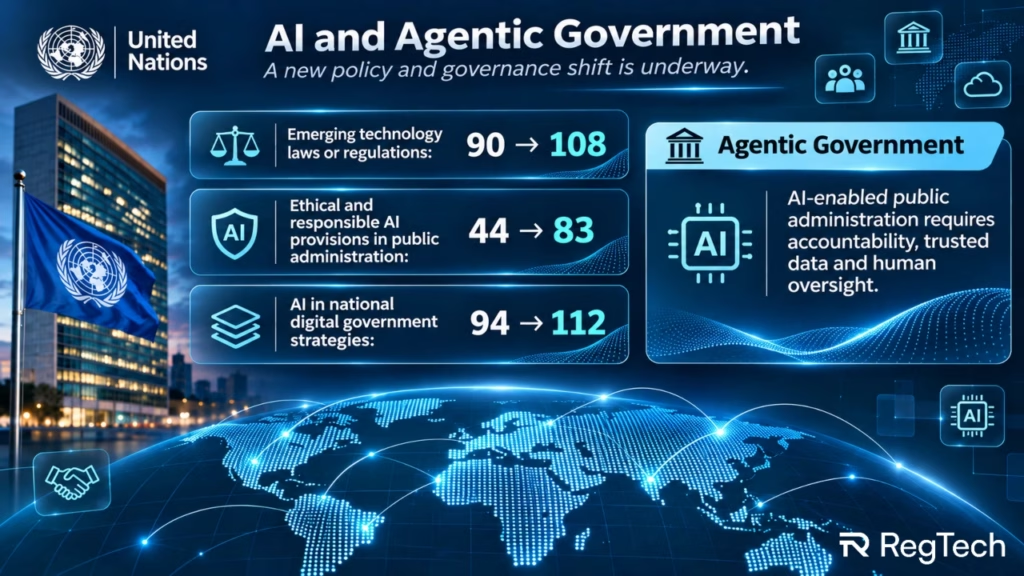
According to accumulated Member State Questionnaire results, the number of countries reporting laws or regulations addressing emerging technologies increased from 90 to 108. The number reporting legal or regulatory provisions concerning ethical and responsible AI in public administration rose from 44 to 83.
References to AI in national digital government strategies also increased, from 94 to 112 countries. These figures are based on different sets of questionnaire respondents and include information carried forward from previous survey cycles. They therefore demonstrate the growing institutional attention devoted to AI without establishing the maturity or effectiveness of individual national systems.
The next stage will demand capable regulators, experienced public officials and reliable mechanisms for assessing automated systems. Governments must understand the technologies they procure, define acceptable levels of autonomy and ensure that decisions remain explainable and open to challenge. Institutional competence will become increasingly important as AI assumes a more substantial role in administrative operations.
Digital Sovereignty and the Emerging AI Divide
Agentic Government introduces difficult questions concerning control over public information and critical infrastructure. Increasingly sophisticated AI systems may depend on externally supplied computing resources, cloud platforms, proprietary models and distributed data environments.
The Survey examines digital, data and virtual sovereignty as relevant foundations for the responsible development of intelligent public administration. These concepts concern governments’ ability to determine how information is accessed, processed, shared and protected across technological systems and jurisdictions.
The implications are especially important for developing economies. Countries with limited computing capacity, scarce technical expertise and constrained public budgets may become increasingly dependent on foreign technology providers. Such dependencies could influence operating costs, institutional autonomy and governments’ ability to supervise critical administrative functions.
International cooperation offers opportunities to address these challenges. Shared technical expertise, interoperable standards, regional infrastructure arrangements and knowledge exchange could improve access to responsible AI capabilities. The United Nations discusses a proposed Centre for Digital Government, organized through a collaborative hub-and-spoke model, as one possible mechanism for strengthening institutional capacity and international cooperation.
UN eGovernment Index 2026: The Road to 2030
The 2026 findings arrive with only four years remaining until the target date for the United Nations Sustainable Development Goals. Digital government has become an important component of national development strategies, influencing access to public services, administrative efficiency and opportunities for economic participation.
The immediate priorities are increasingly identifiable. Governments need reliable and affordable connectivity, accessible public services, strong digital identification and authentication arrangements, interoperable information systems and sustained investment in human capital.
Institutional reform deserves comparable attention. Public agencies must develop the capability to manage complex digital programmes, evaluate technology investments, protect sensitive information and ensure that administrative procedures remain legally accountable. These responsibilities become more demanding as artificial intelligence enters government operations.
International cooperation will remain essential, particularly for least developed countries, landlocked developing economies and small island developing states. Differentiated support can help governments establish resilient infrastructure, develop domestic expertise and adapt international practices to local administrative conditions. The experience of countries advancing rapidly from modest starting points provides valuable opportunities for this exchange.

We are here to help governments, financial institutions, and businesses to effectively comply with growing regulatory requirements through technology.